Showing posts with label Burke-Gilman trail. Show all posts

Sunday, April 10, 2011

A Dose of Sanity

With some trepidation, I checked out the details of the Burke Gilman Trail capital improvement project set to begin construction next month. The project summary says all the right things: twelve-foot-wide asphalt surface, a gravel side path, improved sight distances. The descriptors that I wasn't sure how to interpret were "improved intersection and crossing treatments" and "new signage."

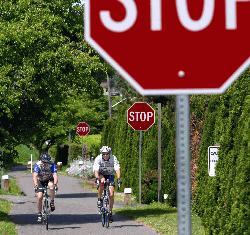
As a resident of Lake Forest Park I've long suffered the ignominy of residing in one of the most backward-looking communities of the trail system. Six stop signs dot a half-mile section of the trail between 147th and about 155th, some of them protecting nothing more than driveways. 1300 - 2200 bicycles per day are expected to stop for a dozen or two cars per day? Insanity! Welcome to Lake Forest Park.

King County has long wanted to bring the LFP section of the trail into conformance with the rest of it, but has been strenuously resisted. In 2006, after lengthy discussions and debates with residents, the Lake Forest Park city council passed Ordinance 951, which attempted to regulate the section of the Burke-Gilman trail that passes through the city as a "conditional-use" trail, subject to restrictive local regulations such as:
  • A speed limit of 10 mph (the trail standard is 15 mph)
  • Yield or stop signs for bike traffic at street crossings, even if the crossings were no more than driveways
  • Setback standards from adjacent property, even if that meant narrow trails and poor sight distances
To legal arguments that the Burke-Gilman trail was an "essential public facility," giving it enhanced standing over purely local pathways, the council gave a collective shrug. It was as if the city of Lake Forest Park decided to take control of a section of Interstate 5 and impose a 40-mph speed limit, traffic signals, and lane restrictions.

I participated in a public hearing prior to its passing, in which roughly three-quarters of the public comments were vehemently against the ordinance. Nearly everyone who spoke in favor of the ordinance resided along the trail and presented classic NIMBY arguments. A lawyer assured the council that the ordinance would be challenged and almost certainly overturned (it was); a traffic expert pointed out that the proposed signage was contrary to common practice and common sense.  Nevertheless the council (one of whose members actually lives adjacent to the trail) passed the resolution.

Shortly after its passing, the Cascade Bicycle Club joined King County in challenging the ordinance, and in 2007 it was overturned by the Central Puget Sound Growth Management Hearings Board. King County subsequently embarked on the improvement project, and four years later they're ready to break ground.

So what about the "improved intersection and crossing treatments" and "new signage"? The future state is specified in great detail in the project documents, and after looking them over in detail I can report that the future is bright, indeed:
  • All trail-facing stop signs will be removed from 147th through 165th (I hadn't dared hope for 165th), to be replaced by "Look" warning signs.
  • All roads and driveways crossing the trail from 147th through 165th will have stop signs and improved visibility of the trail.
Score one for common sense!

Now if someone could just help Shoreline out a little...

Thursday, December 9, 2010

Increasing rudeness on the trail

As I've posted before, one reason I love bike commuting is to escape the rat-race mentality. The ability to go where you want, at the speed you want, without being hampered by heavy traffic, leads to a calmer ethos on the bike trail than you find in a car at rush-hour. But perhaps bike commuters are beginning to pay the price of their own success. As more of us take to our bikes, tensions inevitably will rise.

I had two experiences within a week of each other that lead me to believe we are beginning to see a transition. In the first, I was approaching 15th Avenue NE in the U District from the east. There's no traffic light there, but there is a stop sign, so I always do a "biker's stop" before crossing, meaning that I slow down enough that I could stop cold if I had to, and then assess the situation as I approach the street. In this case there was another biker in front of me who came to a complete stop, so I moved left to pass, checked the traffic, and saw that the only approaching vehicle was a shuttle bus coming from the south. Since I could easily cross before it got near I accelerated across the street and settled back into my ride.

A block or so later the biker who had stopped caught up with me and started yelling. From her perspective it appeared that I had simply powered through the stop sign, making me one of the bad guys giving bicyclists a bad name. I defended my actions (in the heat of the moment I claimed to have actually stopped, whereas the truth was that I had merely slowed down), but of course there was no agreement. It ate at me for awhile, and then I put it aside as an unfortunate misunderstanding.

A few days later I was approaching 65th from the north, slowed to a crawl, and then proceeded when the lone approaching vehicle slowed and was apparently waiting for me. As I crossed I waved, as I always do, but when I got across the street I heard a string of invective from the driver. Evidently I had misunderstood his intentions. This incident disturbed me even more than the prior one, because it made me wonder whether in fact I was as much in the "good guys" camp as I had thought. Could it be I was actually one of the aggressive bicyclists that everyone hates?

These two incidents have made me change my behavior. Although I had considered myself one of the more conservative riders on the trail, I have become even more conservative. But after much reflection I have come to the conclusion that I really am, and always have been, one of the "good guys." The fact that I'm encountering more conflict recently is, I believe, due to the increasing tension that increasing numbers of bicyclists causes. Drivers have had more negative experiences with bikes, and are therefore quicker to lose their cool. Other bikers, stung by bikers' increasingly bad rep, are quicker to judge their fellow commuters. It all leads to greater tension, and the beginnings of the rat-race mentality I so much want to escape.

I think we've reached an inflection point. Seattle has recently been named one of the most bike-friendly cities in the nation, but we're still nowhere near where some European cities are. We're moving in the right direction, and we have recently crossed a threshold where car drivers encounter bikes with such regularity that it's no longer just the odd circumstance when a road is shared by both cars and bikes, it's the norm. But we don't yet have a good enough network of trails and bike-only lanes to bring some order to the process.

As a hopeless optimist, I see all this as generally a good thing. More bikes is better, and though the inevitable conflict it engenders is unpleasant, the future is bright. Let's see if we can all keep this perspective. And if you happen to see agressive behavior by a biker with a big black trunk sporting an "I brake for lemonade" bumper sticker, give him the benefit of the doubt. He's doing the best he can.

Thursday, May 20, 2010

How safe is bike-commuting?

There are 1.25 fatalities for every 100,000,000 miles driven in a car. That doesn't seem like much, but if you travel 20,000 miles per year for 50 years it works out to a better than 1% chance that you will die in a car crash.

The statistics for bicycling are less complete, but such as they are they suggest that the rate per mile is about ten times as high compared to driving. To keep calculations simple let's just call it 10 fatalities per 100,000,000 miles.

Call me chicken, but this is alarming. Applying the statistics directly to my own situation, I ride upwards of 5,000 miles per year, giving me odds of 1:20,000 of dying this year while biking. Over a 20-year career that's a one-in-a-thousand chance of getting killed. Compare this to other risky activities:

  • Skydiving (per jump): 1:100,000
  • Killed by lightning (lifetime): 1:100,000
  • Plane crash (per trip): 1:1,000,000

The EPA, when assessing the risk of pollution levels, typically sets one in a million as unacceptably high. I'm comfortable with a one-in-a million risk; one in a thousand, not so much.

So how can I go about mitigating this risk? Quite a lot, I believe. What I see on the road convinces me that there is a lot of opportunity for bicyclists to improve their own chance for survival. To be honest, I'm astonished at the foolhardiness of many bikers. Here is just a small sample of behavior I've seen:

  • Crossing a busy intersection without checking whether car traffic is aware of you. I actually saw someone get hit crossing 65th this way, and I've seen several close calls on Stone Way. How hard is it to look left and right?
  • This one's similar: going straight through an intersection without looking for oncoming left-turners, or right-turners coming up behind you. At least one recent fatality in Seattle was caused by this situation. It's not much comfort to claim that the car was at fault.
  • Riding on unsuitable roads, such as Aurora Avenue North (which also happened to be the location of the above-mentioned fatality).
  • Riding at night in dark clothing with no lights. As a car driver with aging eyesight, I can assure you this renders you practically invisible.

I maintain that simply by taking common-sense precautions, the risk of accident can be dropped substantially. Statistics back this up. For example, one blogger has assembled data showing that young, inexperienced cyclists incur accidents at greater than ten times the rate of experienced cyclists.

But even experienced cyclists take risks that I myself avoid, so I believe in my case the risk is lower still. I know I've annoyed many a bicyclist with my cautious riding on the Burke-Gilman trail. Because of poor visibility I slow nearly to a stop at 70th and 65th to make sure no one's coming; I won't cross in front of a car until I make eye contact with the driver and have been given a clear signal to cross, particularly at high-traffic crossings like Blakely.

Recently I've been looking for the best route between Fremont and the Interbay Golf Course on Magnolia. My first attempt took me over an unacceptably steep hill. On my second attempt I tried a route that crossed the Ballard bridge, taking me within a few blocks of my destination, only to find that the pedestrian walkway on the other side didn't continue along 15th NW. My only options were to follow the safe route away from my destination, or to ride on the street. One look at the street convinced me to bail. I ended up taking a 15-minute detour just to avoid the traffic. Finally on my third try I found a suitable route that was pleasant, direct, and safe.

I have the added advantage that nearly 90% of my commute trip is along the Burke-Gilman trail, away from auto traffic entirely except for the street crossings. Cautious riding, experience, and a favorable route combine to reduce my personal risk to perhaps as low as 1:100,000 lifetime, I estimate.

That's still not one in a million, but it's almost certainly lower than the risk I would incur driving to work instead. Yet one more reason to ride!

Monday, August 17, 2009

Why the Zig-Zag Route?

A new section of the Interurban trail opened about two years ago, offering a welcome overpass over the busy intersection of Aurora and 155th, and another one over Aurora itself just a long block to the north. For a north-south commuter like me this is a great addition to the trail system. In 1993 I used to commute this route without any trails, and the best option at the time was to ride right on Aurora between 155th and 145th. Ah, to be young and foolish!

So why am I getting ready to complain? Am I never satisfied?

Here's why: to cover the short stretch from the southwest corner of 155th and Aurora to the east side of Aurora at 157th, a biker must negotiate a tight 180° off-ramp that sends you away from where you want to go, around a blind corner at the base of the bridge to head back north again, to a stop sign that doesn't seem to serve any useful purpose (since changed to a yield sign, through a fit of common sense), back up a tight 315° on-ramp, and finally down a more rational north-facing ramp back to street level.

Walkers can shorten the trip by using stairs, but bikes (and wheelchairs) have to follow this tortuous route. I have to ask: why all the zig-zags?I can think of a couple reasons, both of them cynical:
  1. The powers that be do not want bikes traveling at a high rate of speed, so obstructions were put there intentionally. There is a precedent for this: the Burke-Gilman trail through Lake Forest Park was "unstraightened" to slow bikes down as they approached driveway crossings. This is a sin that appears on its way to being corrected; why do more of the same in Shoreline?
  2. The powers that be are clueless about what makes a suitable bike trail.
Although the situation at 155th and Aurora seems almost intentionally obstructionist, I'm leaning toward the second explanation, chiefly based on evidence from the very same trail just a mile farther north. Between 175th and 182nd the trail makes its way along a wide grassy expanse between Aurora to the west and Midvale to the east. Though the two roads are perfectly straight along this stretch, the trail meanders left and right between the two, no doubt for obscure aesthetic reasons. Just before 182nd it lurches to the right towards Midvale, lurches left across 182nd, followed immediately by 90°, 135°, and 45° turns before heading north again. What the...?

It looks for all the world like someone penned in a gracefully meandering trail to serve as counterpoint to the surrounding Cartesian asphalt grid, then smacked their head at 182nd and said, "Whoa, there, we can't cross here next to Aurora, it's too dangerous! Better head over to Midvale!" The result just seems too lame to be diabolical; it must be incompetence.

So as a public service, I hereby offer my expertise as a dedicated bicycle commuter to the poor clueless schmucks trying to spend the trail dollars we've approved. I have a couple principles that, if followed, will make life better for everyone:

  1. Straighter is better. Meandering trails are great for hikes in the country; for commutes through the city they just mean added distance and reduced speed.

  2. Wider is better, too. Pedestrians are safer, collisions are reduced, and bikers are happier.

  3. When bike traffic exceeds car traffic at an intersection, aim the stop signs toward the cars, not the bikes.

  4. Sectioned concrete is great for sidewalks, but it's terrible for bike trails. Use asphalt, please.
In many places bikes are still not seen as real vehicles, doing real business. Eventually the word will get out that there are large numbers of us for whom bike riding is a way of life, not a weekend diversion. Shoreline hasn't got the message yet, but the changes coming to the Burke-Gilman trail in Lake Forest Park give me hope that other places have. The future is on our side. Let's all do our best to make it come sooner rather than later.

Saturday, April 4, 2009

Spare Time

Commuting by bike takes time. It takes me two hours and fifteen minutes to get to work from the time I wake up. So to be at work at 8:00, I have to wake up at 5:45. If I were to drive I could sleep until 6:30 and on most days still get to work by 8:00. Multiply this difference by two and it amounts to an hour and a half of lost time every work day. Ouch!

Time is a precious commodity for most people who have both a job and a family, and I'm no exception. I can't count how many books I could have read or projects I could have accomplished if only there were more hours in a day. As my kids have matured I've begun to experience more free time, but it still isn't enough. How can I justify losing an hour and a half every day of the week just so I can ride my bike?

One justification could be that I'm in better shape because of it, so I feel better and have more energy, so it's not really that much time, blah, blah, blah. While there's some truth in that, it's far too fuzzy an analysis for my taste. Who's to say I couldn't come up with an equally good way to get exercise that doesn't take so much time? Like, say, join the Sound Mind & Body gym across the street and work out during lunch. Or do yoga while watching the 10:00 news.

Instead, I'm just going to start from the fact that I like bike commuting and I'm going to do it regardless, and then try to estimate the true cost in terms of free time, similar to the way I estimated the true financial cost of bike commuting. I maintain that I lose far less than an hour and a half, once all factors are taken into account.

I used to be a dedicated bus commuter when I worked in Bellevue and had a decent, transfer-free route to take.  This was when the kids were small and free time at home was nearly non-existent. It got so I looked forward to the bus ride because then I finally got to sit down and work on whatever project I wanted to for nearly an hour, uninterrupted. I intentionally avoided getting to know my fellow commuters, the better to read books, study whatever my latest kick was, and basically have two hours of total self-indulgence. It kept me sane.

When I became a full-time bike commuter I had to give that up, and it was painful. Though the ride was still cathartic, I got less reading and studying done, and I missed it. If there had been a decent bus route I would probably still be primarily a bus rider, but there wasn't, so I'm stuck with the bike commute.

(Okay, so I'm not "stuck" with it. I could drive, but driving is simply not an option at this point. Just jumping back into the rat race once a week so I can join my coworkers after work for golf at Interbay feels yucky. I could also ride a van pool, but I find even that doesn't allow me to escape the stress of the commute, because my fellow riders seem to be obsessed with finding the best way to beat traffic every day. It's nothing like the anonymous, care-free bus commute I gave up).

Well, then. After a couple years I decided to start listening to the radio during my commute. I found a nice over-ear radio that doesn't interfere with the helmet, and started listening to NPR's Morning Edition and All Things Considered. Eventually I realized that I was getting all my need for news fulfilled, and didn't get much out of the daily paper anymore. So I reduced my newspaper-reading to a quick skim, or sometimes didn't read it at all.  That's a half-hour saved.

Eventually the news got too depressing (starting late 2002 — you figure it out), and I decided two hours a day of this stuff was too much. Talk radio was out (how can anyone can stand to listen to that stuff?), and baseball wasn't on frequently enough. I started listening to music more. But I didn't really hit on the right solution until a year ago or so when I discovered audio books. Put them on an iPod and away you go!

In the space of a few months I had listened to Jules Verne's "The Master of the World," Chesterton's "The Man who was Thursday," Thoreau's "Walden", and Wodehouse's "My Man Jeeves," all of which are in the public domain and available for free from Librivox. OK, so the quality of the volunteer readers isn't uniformly excellent, but most of them aren't bad at all.

Later in the year I learned how to record streaming audio as an mp3 file using the excellent program Audio Hijack Pro (available only for Mac, sadly). I have it set up to automatically record A Prairie Home Companion from KUOW's streaming audio every Saturday from 3-5 p.m., and it takes just a minute to transfer it to my iPod. I've been adding the occasional podcast also — two shows I listen to regularly are This American Life and CBC Radio's The Vinyl Cafe.

As I've moved away from news and into podcasts and audio books, I find I'm reading the newspaper a little more frequently again, though it's not really equivalent. The newspaper is very similar in content and depth to what I read on Yahoo News at odd moments during the day. NPR gives me much deeper reporting. But in general I'm getting my weekly news fix partly during my commute and partly other ways, and still finding plenty of time for my podcasts and the occasional audio book.

So let's get scientific about this and compare the free-time cost of driving versus bike commuting. The bike commute takes about 15 hours/week and the car commute 7.5 hours/week. Here's how that time is spent:

Activity     Bike          Car
Preparation (changing clothes, etc.)3:000:00
Listening to NPR/other news4:006:30
Radio shows3:300:00
Audio books1:300:00
Music1:001:00
Silence/thinking2:000:00

These are rough estimates, and it varies widely week to week. But I think it's clear that I make good use of the time spent on my bike, and my "lost time" is really only the roughly three hours extra preparation per week it takes — rolling up my work clothes into a bundle, packing up my bike trunk, filling the water bottle, changing three times a day. (You'd think all that would take less than 3 hours, but the stats don't lie).

Now we can talk about whether the sacrifice is worth it. Three hours a week to stay in shape, feel better, get ten hours/week of biking in the fresh air (hey, I like to do this), escape the rat race — well, what do you think?

Saturday, March 28, 2009

Trail Types

When you ride the same route day after day, year after year, you start to notice patterns of behavior in your fellow travelers. I've been keeping a mental list of "trail types" for years, and I finally decided it's time to put some of these observations down in writing. Some types are comical, others irritating, and some are just plain weird. I hope you find this amusing.

The Regular (Pedestrian)
A Regular is a pedestrian who knows what's what on the trail. Regulars always walk in straight lines, usually on the right side of the trail; they never bunch up and block traffic; they generally move steadily and briskly. They usually are either alone or with a single companion.

Regular walkers recognize and greet us regular riders when we pass. Sometimes friendships are formed. I often see Suzie (not her real name) exchange hand-slaps with each of the Old Geezers (see below) as they ride past, and they sometimes stop to talk. The trail is a real, if mobile, community.

The Foghorn (Bike)
This one's a puzzle to me. You know how when cell phones first started getting popular it took users awhile to figure out that you didn't have to shout into one to be heard, regardless of how difficult a time you were having hearing? The cell phone shouter seems to be fading into the past, but his bike-riding cousin is alive and well. The Foghorn can be heard approaching from 200 yards away, gabbing constantly and LOUDLY to his companion(s). Here's a typical conversation:

FOGHORN: ...SO I WAS AT THE GYM WHEN GUNTHER TOLD ME ABOUT THE PARTY AT JOJO'S.
COMPANION:  (inaudible reply)
FOGHORN:  NO FOOLIN!? THAT'S WHAT I TOLD HIM TOO!
COMPANION:  (barely audible mumble)
FOGHORN: OH, I KNOW, I KNOW! IT'S LIKE THAT TIME WHEN WE WERE...

and so on. It sounds like one side of a phone conversation until they get within a few feet, when I might catch a word or two from the companion before they pass.

This type is always a hard rider, which makes me wonder whether there's some physical connection between the leg muscles and the diaphragm that expels the words out forcefully during a hard workout. Or possibly the Foghorns are loud all the time; I'll never know since they disappear so fast.

The Old Geezers (Bike)
There's a group of retirement-age men who ride the trail every day from somewhere around Matthews beach up to Third Place Books in Lake Forest Park. I don't believe they ever miss a day, regardless of how nasty the weather is.

They're a class unto themselves, and a wonderful addition to the trail culture. They ride slowly, usually two-by-two, but are conscientious to make room for anyone who wants to pass. Quirky adornments add to the character of the group, like an amusing bell, or a little flag flying from a helmet.

I once told them I'd like to join their group when I retire. I was informed that would automatically make me president until I could find a newer member to pass the responsibility on to. Here's hoping they're still around when that day comes.

The Commuter (Bike)
This is my group, of course, so I'm probably not qualified to provide an unbiased description. I'm not so sure we commuters really have a whole lot of traits in common, though. One common trait is that we all generally have a waterproof way to transport our clothes. I have a hard plastic trunk, but Ortlieb panniers or packs are more common.

Commuters run the gamut from slow to fast. Some Commuters seem to also be Fitness Geeks or Racers (see below).

The Clueless (Pedestrian, usually)
The first really warm spring day brings out the Clueless in droves. They wander all over the trail or stride right down the middle, huddle in packs, dart unpredictably, and generally raise the danger level on the trail for everyone, especially themselves.

Another prime viewing time for the Clueless seeker is the first week of fall quarter at the UW. Clueless freshmen (particularly athletes, for some reason) have no idea what "shared use" means, and they show up in incredible numbers. They provide a valuable source of data for researching how long it takes to clue in. Next fall I hope to conduct some experiments, but from memory I'd say it generally takes about two weeks to convert them all to fine, upstanding members of the trail community. Here's a rough outline of their progress:

Day 1: Unresponsive to voice or bell; appear confused when they hear, "On your left."

Day 3: Look annoyed when you ask them to make room; but at least they notice you.

Day 5: Look resigned when you ask them to make room; start to walk in straighter lines near the edge of the trail.

Day 10: No longer plug the trail in packs; look over their shoulder before crossing.

The Newb (Bike, Pedestrian)
The Newb is clueless but enthusiastically interested in the "trail" experience. They smile at and greet everyone they pass, which is sort of nice but you just can't keep that up forever. Newb bikers make copious use of their new bell, often unintentionally frightening pedestrians by not signaling soon enough. They tend to weave back and forth, sometimes in cadence with the downstroke on their pedals. Be nice to them; they mean well.

The Fitness Geek (Bike)
The Fitness Geek is on a schedule, and woe to the biker or pedestrian who becomes an obstacle in his path. You can see the heart rate monitor strapped to his arm as he blows past, head down so he can keep track of the readouts on his comp. Sometimes they're on some kind of program with varying intensity levels, because I'll see them later, riding slowly and actually looking around a little.

The Racer (Bike)
This type is closely related to the fitness geek. He, too, is very goal-oriented, but the goal isn't related to heart rate or time, but to the destination. Anything that slows the Racer down is an intense irritant: traffic lights, Clueless pedestrians, even slower riders like myself.

A Racer is not thrilled about sharing the trail with you. You are tolerated only if you are conveniently off to the side and by yourself, so that he can pass without breaking stride.

Here's a diagnostic trait: when riding past Gasworks Park, a Racer eschews the official trail because of its sinuous path from road to sidewalk and back, and instead just rides on Northlake Way, a pot-holed two-lane road with no shoulder. I estimate they save at most two seconds by this maneuver. I haven't yet discovered the calculus by which they conclude that this is worth the risk.

The Quirks
This is just a catch-all category for the interesting unclassifiables I run into. You've got your power-assist bikers here, your unicyclists, your shopping cart ladies, your tai-chi practitioners. For a year or so I was seeing someone riding a hyper-tall bike — no idea where he came from or why. I used to see a woman regularly running the trail near 77th — backwards.

The trail is for everyone. Why not add your own quirky self to the mix? We'll all be the better for it.
Wednesday, December 10, 2008

Stop for Lemonade


I brake for lemonade

That's a bumper sticker I have on my bicycle trunk; it's also a true statement. I have never, in recent memory, failed to stop at a trailside lemonade stand. I just can't get enough of that sticky, sour-sweet liquid goodness.

Actually, there's more to it than that. You may remember, if you were a trail-rider or just a follower of the local news, that in 2006 teenager Laura D'Asaro raised thousands of dollars selling lemonade on the Burke-Gilman trail just north of Matthews Beach, which went towards improving the local playground. I was a regular customer, and as the summer wore on she started calling me "trunk guy" because of the afore-mentioned bicycle trunk (sans the afore-mentioned bumper sticker, which came later). Besides getting a nice refreshment midway through my ride, my contributions were going towards a cause.

Then there are the young entrepreneurs that I feel good about supporting. It takes a certain level of initiative to put together a lemonade stand, and I want to reward that. Once there were two stands within a couple hundred feet of each other near the Ronald McDonald house on 40th. I stopped at both of them, had a couple of lemonades, and sloshed my way home.

But neither of these really get to the heart of the issue. I stop for lemonade because — well, because I can. If my life is too busy or my commute too rushed to take five minutes to enjoy a cup of lemonade, then my life is too busy, and my commute is too rushed. And that is not the way I want to live my life.

Some people ride the trail for exercise, decked out with heart rate monitors and whiz-bang computer gizmos that tell them exactly how much of a workout they're getting. I see them whizzing past, heads down, legs pumping, weaving around obstacles without slacking their pace (I plan to write a column at some point on trail types — these are the fitness junkies). Others are heads-down commuters on a schedule. I'm a commuter, yes, but I'm doing it to escape the rat race, not just participate in a different form of it. Stopping for lemonade is a way to prove to myself that I haven't back-slidden into commuter hell. The day I have to pass up a lemonade stand because I don't have the time is the day I need to take stock and figure out what needs to be changed. Lemonade stands are my personal canaries in a coal mine.

Sadly, there are precious few lemonade stands. Aside from the anomaly of 2006, when Laura's very reliable stand was a daily fixture, I doubt I stop more than half a dozen times in a typical year. What happened?

I'm trying hard not to use the phrase, "In our culture...," an overused subordinate clause that irritates me no end; as if everyone were some kind of anthropologist. But really, what's going on when a perfectly viable means means of earning spending money is not being taken advantage of? What else can it mean but that the kids that in former generations needed to earn cash are, today, just given everything they need by their doting parents?

Perhaps lemonade stands are coal-mine canaries in another sense. When they die, they are an early indicator of an unhealthy consumerism and materialism in a ... no, I won't use the word! Just end it there: unhealthy consumerism and materialism.

We've been hearing since the 1980's that consumer spending drives the economy, and that we're actually doing a good deed when we spend as much as we possibly can, because every dollar we spend cycles through the economy x number of times and increases the national wealth by a factor of ... yada, yada, yada. Evidence from the trail tells me that today's parents have taken that teaching so much to heart that their children no longer feel the need to work for their toys. Call me a fuddy-duddy, but I think that's a shame.

If this financial meltdown we're now in the middle of turns into a major recession or depression, things may change. When parents start scrimping and saving, and maybe even, perish the thought, skip one generation of Wii/XBox/PS, what will their children do for entertainment? Might they actually have to (gasp!) rustle up some spending money all on their own?

I've got my eye on the trailside lemonade indicator. I'll let you know.